


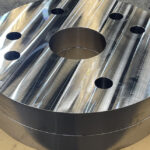
Exploring the Secrets of Special Steels for Mechanical Construction
30 de April de 2024
Toolox 33 vs. 1.2311: Superiority in Ductility and Fatigue Resistance in High Quality Steels
25 de June de 2024
In the vast world of metallurgy, understanding the mechanical properties of steels is essential to ensure their performance and safety in a wide range of applications. In this article, we will dive into two key tests: the tensile test and the resilience test that provide us with fundamental information about the characteristics and behavior of steels subjected to static and dynamic loading.
The Tensile Test: Revealing Fundamental Mechanical Properties
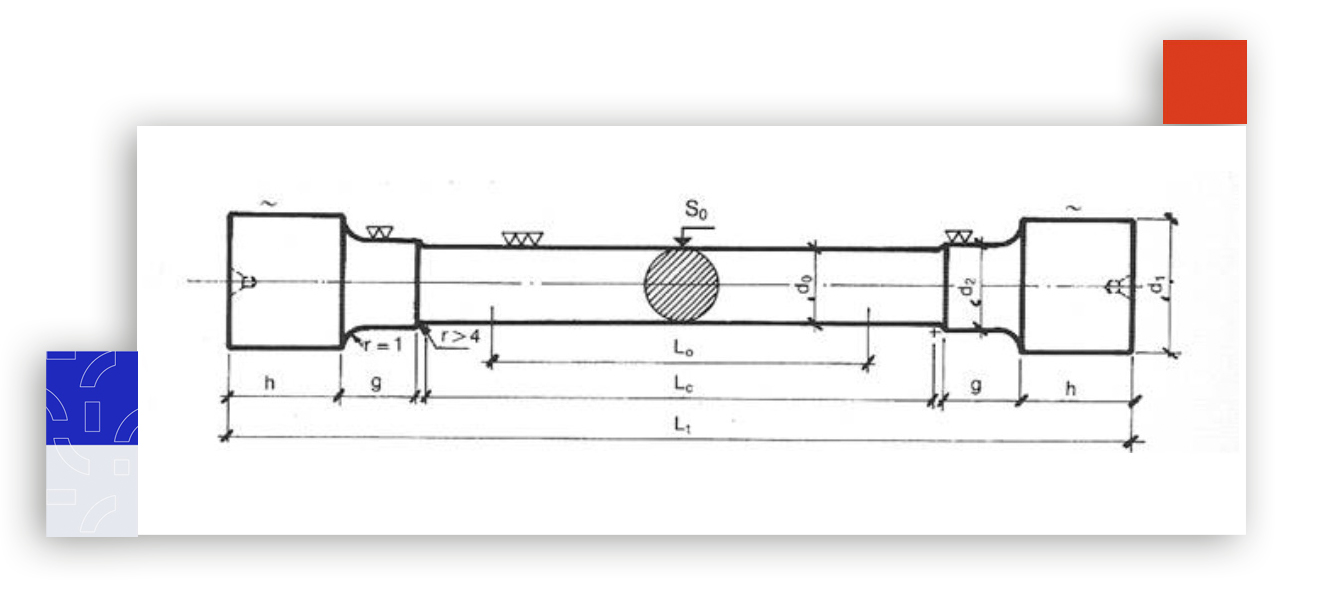
The tensile test is one of the most used methods to know the mechanical properties of steels. During this test, a cylindrical, square or rectangular specimen is subjected to an increasing axial load until it breaks. Throughout this process, data such as tensile strength (R), yield strength (E), elongation (A) and necking (∑) are recorded, providing crucial information about the material’s behavior under load. .

The stress-strain graph generated during the test reveals three distinct zones:
- the elastic zone,
- the elastic-plastic zone
- the breakage of the test tube
Each of these zones offers unique information about the steel’s ability to withstand loads and deformations before failure, allowing engineers and designers to select the most suitable material for each specific application.
The Resilience Test: Challenging the Limits of Material
Many in-service breakages of engine, vehicle and machine parts occur as a result of supporting dynamic stresses that challenge the toughness of the material. To evaluate the shock resistance of steels, the toughness/fragility test is carried out, which assesses the energy necessary to break a steel specimen with a single blow, tested on the Charpy pendulum.
This test complements the static tensile test, providing information on the steel’s ability to absorb energy and resist sudden fractures under dynamic conditions. The toughness of steel, measured in joules of energy absorbed during the test, is influenced by various factors, including chemical composition, heat treatment, grain size and fiber orientation, among others.
CHARPY PENDULUM
- The test piece placed on 2 supports separated by 40mm
- The notch on the side opposite to the blow of the mace
- The mace with a 30º angle blade and r = 1mm
- The higher the height, the greater the fragility
- Absorbed energy = h – h´
- Result: average value of 3 test tubes

The standard test piece is 10mm and 55mm long, with a U or V-shaped notch on one side, in the middle of its length. For low temperature tests the notch is V-shaped and 2mm deep. Smaller section specimens can be tested for products with a thickness less than 10mm.
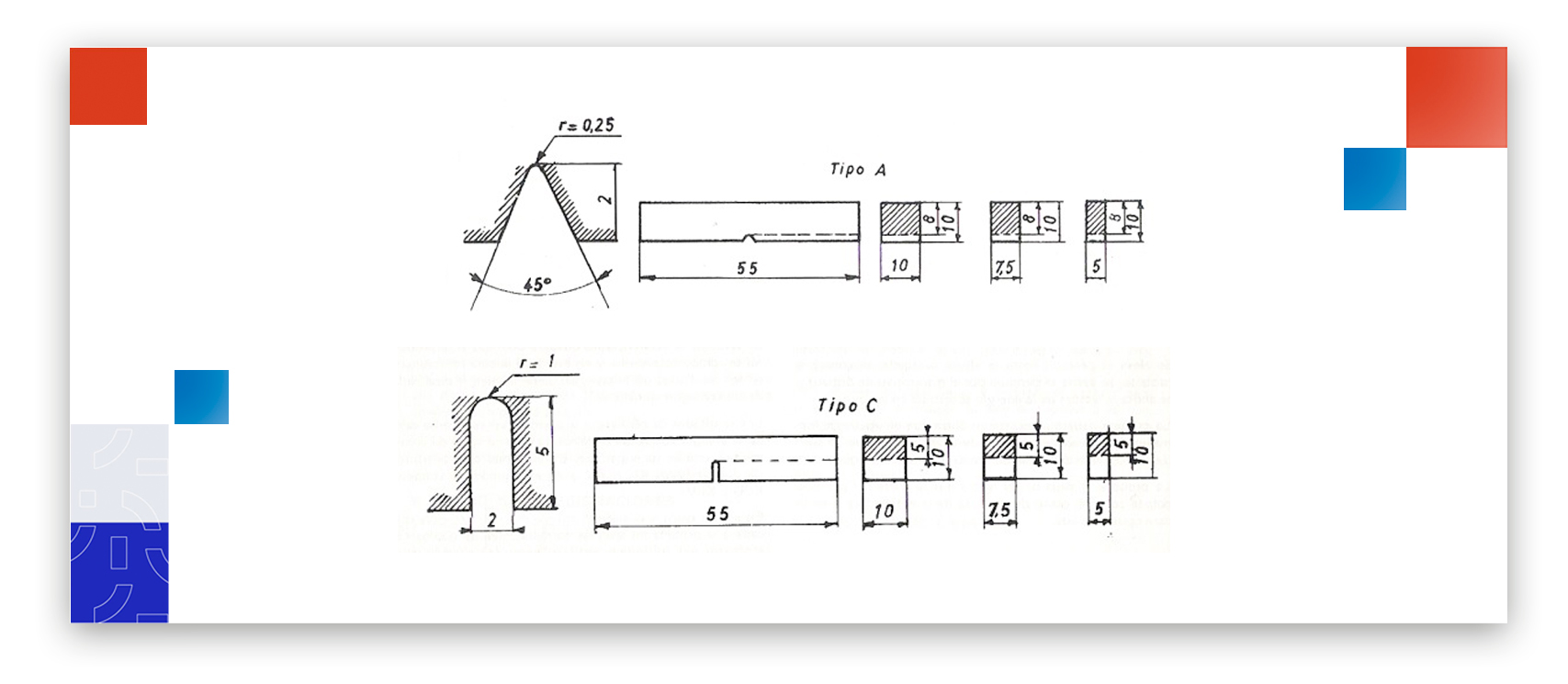
The result is expressed in Joules (J) and is the value of the energy absorbed by the section of the standard specimen. Another way to express this value is in daJ (decajoules), multiplying the joules obtained by 10.
The following table shows other units that are used in the market and their equivalents.
| ENERGY – WORK |
J |
daJ | Kgf.m | Ft.lb |
| 1 J | 1 | 0,1 | 0,102 | 0,7376 |
| 1 daJ | 10 | 1 | 1,02 | 7,376 |
| 1 Kgf.m | 9,81 | 0,981 | 1 | 7,233 |
| 1 ft.lb | 1,356 | 0,1356 | 0,1383 | 1 |
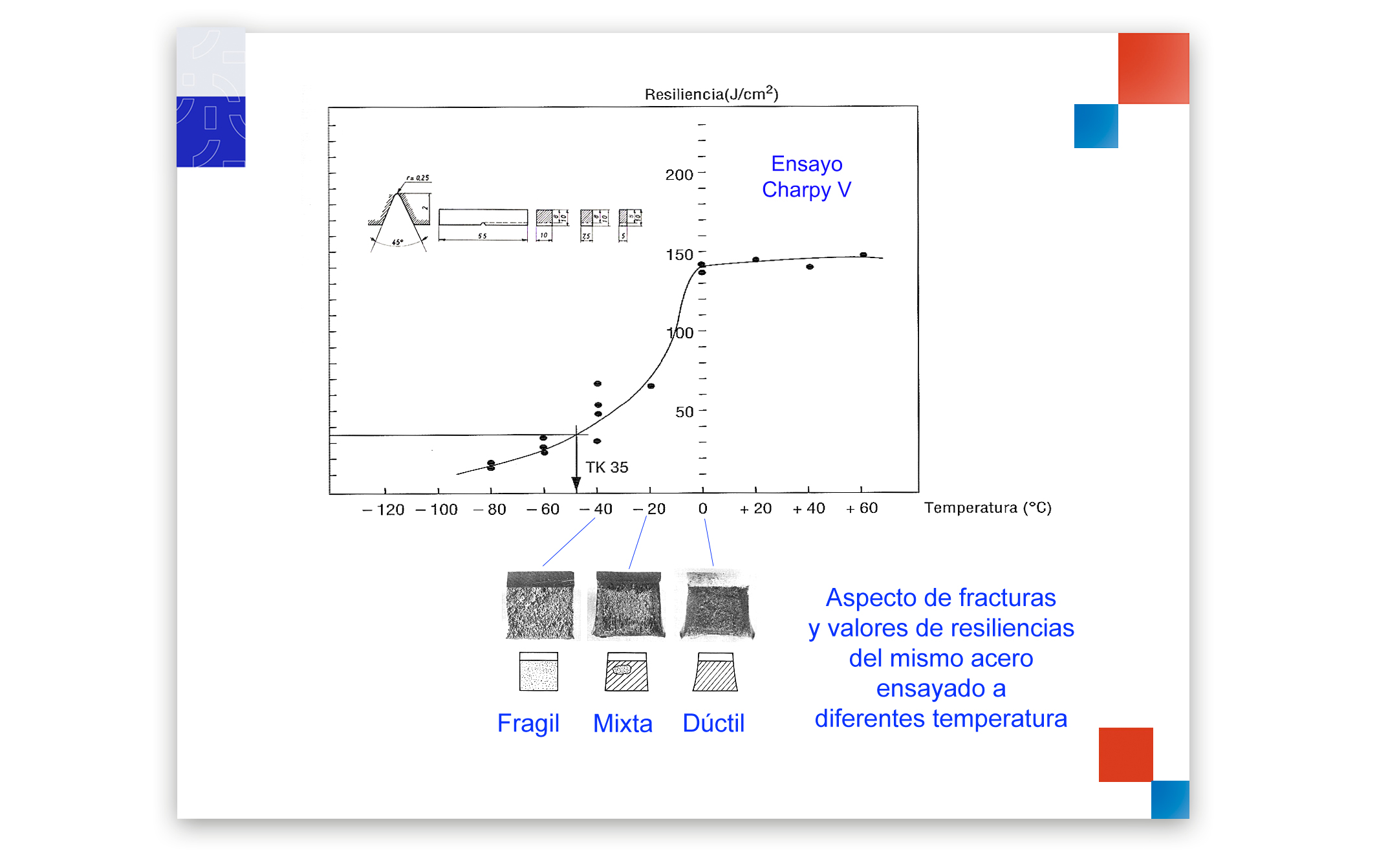
Below 0ºC, what happens to the toughness of steel?
To resolve this uncertainty, it is necessary to know how low temperatures influence toughness. This way we will know how the mechanical components of installations and vehicles will resist the shocks and blows they receive without breaking, when they work in countries where winters are harsh and long. In this way we will avoid premature breakage of steel parts and paralysis of the affected vehicles.
We must also take into account that we can find low temperatures on ski slopes and routes where snow and ice accumulate in winter, making it necessary to use snow plows and other vehicles.
To avoid unpleasant surprises, it is necessary to construct the fragility curve and define the critical temperature marked by the resilience value.
We see an essay that shows this relationship and the types of fracture it generates.
Let us remember that the toughness of steel is a function of:
- The chemical composition
- heat treatment
- grain size
- The orientation of the fiber
- Test tube location
- Test temperature
Conclusions: The Art of Understanding Steels Through Testing
In summary, tensile and toughness/brittle tests are essential tools for understanding the mechanical properties and behavior of steels under load. By leveraging these tests and understanding how various factors influence material properties, engineers and designers can make informed decisions to select the most appropriate steel for each application, ensuring safety and optimal performance in construction projects, manufacturing, and more. there.
Join us in our next article as we further explore the secrets of steels and the tests that reveal them!
Thank you Iñaki Aldayturriaga, for your extensive knowledge of steel.


